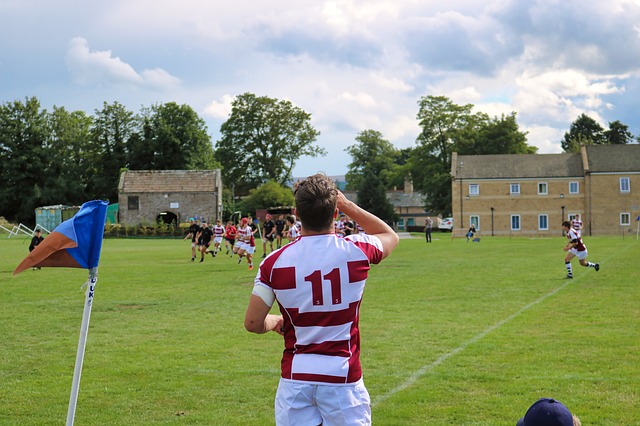
Rugby union is unique in that people of all shapes and sizes can play it right up to the highest level – there is a position for all body types, and temperaments for that matter. As a player, I can vouch for that.
Here are the rugby unionpositions by number:
- Loosehead Prop
- Hooker
- Tighthead prop
- Second Row
- Second Row
- Blindside Flanker
- Openside Flanker
- Number 8
- Scrum Half
- Fly Half
- Left Winger
- Inside Centre
- Outside Centre
- Right Winger
- Fullback
Number 1 to 8 are forwards, while 9 to 15 are backs, and here’s how the positions layout on the field (from a scrum)…
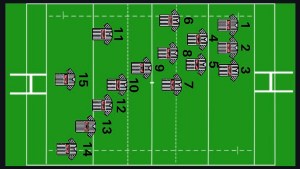
Rugby positions and roles
Each position has its unique roles and responsibilities when it comes to set-pieces and general open play. These can vary but here’s a brief description of each position.
1 & 3 – Props (Loosehead and Tighthead)
The tighthead and loosehead props pack down either side of the hooker at the scrum to form what’s known as the front row.
They are typically strong in both their upper and lower body, being the main forces within the scrum.
Props are also usually used as lifters in the line-out.
Away from the set-piece, they usually make tackles around the fringes of breakdowns in defence and prove as useful ballcarriers in close quarters during attack.
Profile: Heavy, strong upper and lower body.
Notable international props: Gethin Jenkins, Adam Jones, Mako Vunipola.
You might like: Our Guide to the Autumn Nations Series.
2 – Hooker
The hooker is placed between both props at scrum-time and is tasked with ‘hooking’ the ball back during a scrum.
They throw the ball in for line-outs, and must therefore be skilful as well as strong and sturdy.
Hookers tend to be slightly smaller and more dynamic than most props, but are still among the strongest players on the pitch.
Profile: Set-piece masters, good hands and powerful around the park.
Notable international hookers: Dane Coles, Jamie George, Rory Best.
4 & 5 – Second Rows
The second rows – also known as locks – are powerhouses and crucial during set-pieces.
They provide added weight to the front row during scrums and are the target men (jumpers) at line-outs.
Profile: Tall, hard working, and not afraid to put their head where it hurts.
Notable international second rows: Alun Wyn Jones, Paul O’Connell, Maro Itoje.
6 & 7 – Flankers (Blindside and Openside)
Flankers are incredible all-rounders that usually specialise in tackling and jackaling at the breakdown.
They are positioned on the ‘flank’ of the scrum so that they can get away from the set-piece quickly and get to work during open play.
Profile: Mobile, physical, and fit.
Notable international flankers: Richie McCaw, Sean O’Brien, David Pocock.
8 – Number 8
Number 8s are positioned at the back of the scrum and control the ball with their feet, before using it themselves or allowing the scrum half to pass it out to the backs.
In open play, number eights are usually one of the team’s most explosive ball carriers.
Profile: Powerful ball carrier and accurate handling.
Notable international number eights: Xavier Rush, Billy Vunipola, Kieran Read.
You might also like: Scoring for Rugby Union Explained
9 – Scrum Half
The scrum half is typically one of the main leaders within a side, being the link between the forwards and backs.
They pass the ball from the breakdown as well as set-pieces and you’ll often see them sniping around the fringes.
They will also kick from breakdowns (called a box kick) and sometimes take quick tap penalties.
Stereotypically, they are smaller than most players, which seems ironic considering they’re in an around the forwards so often. One of the most complete scrum halves of all time is France and Toulouse’s Antoine Dupont.
Profile: Vocal, agile, nippy and great in support play.
Notable international scrum halves: Conor Murray, Faf de Klerk, Aaron Smith, Antoine Dupont.
10 – Fly Half or Outside Half
A fly half – or an outside half as they’re otherwise known – is usually the focal point of a team. They stand at first receiver and usually receive the ball from the scrum half.
They are typically in charge of running the way the team plays – including calling the moves and acting as a distributor to the rest of the backs.
Kicking is also another major task that fly halves are usually responsible for, particularly restarts and kicking out of hand.
They are leaders, dictate the team’s attack and often have high levels of skills (passing, sniping, kicking, and all-round play).
Profile: Vocal, highly skilful, accurate and able to control a game with their vision.
Notable international fly halves: Dan Biggar, Johnny Sexton, Finn Russell.
11 & 14 – Wingers (Left and Right)
As the speedsters, wingers are positioned on the edge of the field so that they can use their pace to attack as much space as possible.
They vary in terms of body type – just look at the difference between Jonah Lomu and Shane Williams, two of the most famous wingers of all time – but one thing they all have in common is blistering speed at the highest level.
Wingers must also get their defensive positioning right and should be good at catching high balls.
Profile: Quick, agile and serial try scorers.
Notable international wingers: Jonah Lomu, David Campese, Julian Savea.
12 & 13 – Centres (Inside and Outside)
Centres are powerful and dynamic in attack, with good vision and an eye for a gap.
They often take on their opposite number head-to-head, as they defend or run direct lines.
There are different types of centres, but they are usually attacking threats and defensively sound.
Profile: Dynamic running, sound in defence and an eye for a gap.
Notable international centres: Jon Davies, Ma’a Nonu, Matt Giteau.
15 – Fullback
The fullback is the last line of defence and is often tasked with making last-ditch tackles.
Their positioning must therefore be on-point and they should be ready to catch any kicks that come their way. The perfect example of a great defensive fullback is Leigh Halfpenny; any youngster looking to improve their defensive should watch footage of vintage Leigh.
In attack, fullbacks are equally as crucial. They often slot in outside the 13 (outside centre) channel to use their speed in space, or you might see them crashing through the gap between the centres – as someone like Lee Byrne did.
Profile: Strong defence, attacking flair and accurate positioning.
Notable international fullbacks: Leigh Halfpenny, Beauden Barrett, Liam Williams, Stuart Hogg, Cheslin Kolbe.
You might like: The Benefits of Playing Rugby
Rugby union guides at Sport-Reviews
What rugby position should you play? Well, that depends on your preferences!
If you feel you have the ability to play a position, just go for it. The above is simply a guide to how the positions typically play, but it is simply a guideline and there are a lot of generalisations.
After all, rugby is a sport for all shapes and sizes and there are no rules for who can play where.
Some of the best players don’t necessarily “look” like the typical stereotype, just ask Andy Goode!
Regardless of the position you want to be, you can find the best rugby boots or best shoulder pads for you in our extensive guides.
 Sport-Reviews.co.uk
Leave a reply to The Most Capped Rugby Players of All Time – Sport-Reviews Cancel reply